Overview
A client sends a request with a 5 ms timeout. The server takes 30 ms. How long does the client wait?
On QNX, the answer is often 30 ms. And if the server freezes, the client may wait forever, even through SIGKILL.
In this codelab you will build a tiny message-passing server and client and watch that happen on a real QNX 8.0 target. Then you will fix it twice: you write the server-side fix yourself, and you see how a control loop protects itself from a server that can't answer at all.
This behaviour was found by Faultline, a fault-injection tool for QNX 8.0: a 100 Hz pump controller that read its sensor with a 5 ms timeout ran 77 ms late when the sensor froze.
What you'll be able to do
- Explain what
_NTO_CHF_UNBLOCKdoes, and why everyname_attach()server has it. - Predict when
TimerTimeout()will release a client, and when it can't. - Write a server that keeps slow requests as deferred replies and answers
_PULSE_CODE_UNBLOCK. - Structure a periodic loop so a frozen server can't make it miss deadlines.
Prerequisites
- QNX SDP 8.0 on Linux or WSL2, with
qccworking (source ~/qnx800/qnxsdp-env.sh). See Get a Free Non-Commercial QNX 8.0 License. - A QNX 8.0 target you can reach with SSH as root, for example a QEMU image from
mkqnximage --type=qemu. Every output in this codelab comes from QNX 8.0 x86_64 in QEMU with KVM; your timings will differ a little. - Comfort with C. No prior QNX message-passing experience is needed.
- Get the code. It's in the
codelabfolder of the Faultline repository:git clone https://github.com/zuhairhalawa/faultline.git cd faultline/codelab - Build with the QNX toolchain:
source ~/qnx800/qnxsdp-env.sh
make
This builds three programs into
build/x86_64/. For a Raspberry Pi, runmake PLATFORM=aarch64leand usebuild/aarch64le/below. - Copy them to the target:
ssh root@<target-ip> mkdir -p /data/cl scp build/x86_64/cl-* root@<target-ip>:/data/cl/ - Log in to the target and go to the folder:
ssh root@<target-ip>
cd /data/cl
The programs
cl-client [-t TIMEOUT_MS] [-n COUNT] [-w]sends a ping every 100 ms. EachMsgSend()is bounded byTimerTimeout()(5 ms by default) for both the SEND and REPLY states.-wis the control loop from step 7.cl-server [-d DELAY_MS] [-u]registers the namecl-pingwithname_attach()and answers pings.-dmakes every answer late.-uturns on the fix.cl-server-todois the same server with the fix left out. You complete it in step 6.
Each step runs the server in the background (&) and the client in the same shell, so you can signal both. $! holds the pid of the last background process; the steps save it in SP (server) and CP (client). The sleep 1 after starting a server gives it time to start and register its name before the next command signals it or connects to it. Between steps, stop everything with:
slay -s SIGCONT cl-server cl-server-todo 2>/dev/null; slay -s SIGKILL cl-server cl-server-todo cl-client 2>/dev/null./cl-server & SP=$!; sleep 1
./cl-client -n 3server: pid 11907101, name cl-ping, delay 0 ms, naive (sleeps, then replies)
client: pid 11919390, timeout 5 ms
ping 1: reply after 0.0 ms
ping 2: reply after 0.0 ms
ping 3: reply after 0.1 msWhat just happened
QNX message passing is synchronous. One ping goes through three states:
- The client calls
MsgSend(). Until the server receives the message, the client is SEND-blocked. - The server's
MsgReceive()returns the message and anrcvidthat identifies this client. Now the client is REPLY-blocked: it waits until the server answers thatrcvid. - The server calls
MsgReply(rcvid, ...). The kernel copies the answer into the client's buffer, and the client runs again.
TimerTimeout() asks the kernel to stop waiting after 5 ms, in either blocked state. Keep those two states in mind; the rest of the codelab is about the second one.
Now the server answers 30 ms late. The client still sets a 5 ms timeout on every MsgSend().
./cl-server -d 30 & SP=$!; sleep 1
./cl-client -n 3
server: pid 11956253, name cl-ping, delay 30 ms, naive (sleeps, then replies)
client: pid 11968542, timeout 5 ms
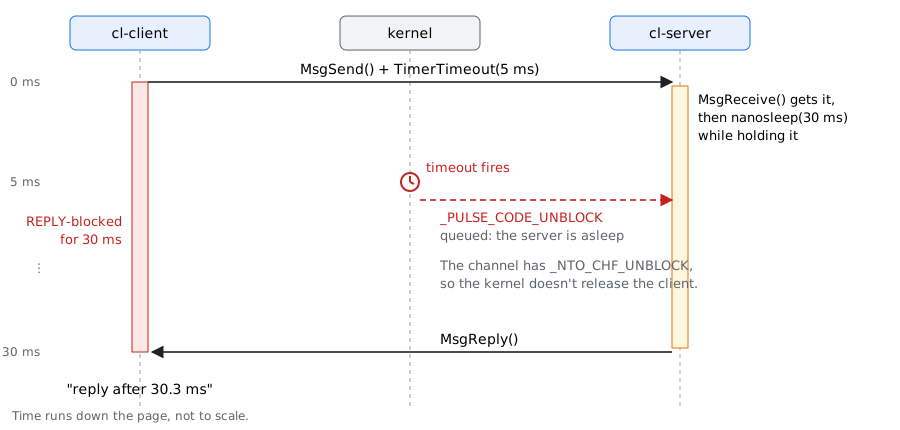
server: got _PULSE_CODE_UNBLOCK (ignored; already replied)
ping 1: reply after 30.3 ms
server: got _PULSE_CODE_UNBLOCK (ignored; already replied)
ping 2: reply after 31.2 ms
server: got _PULSE_CODE_UNBLOCK (ignored; already replied)
ping 3: reply after 31.3 msThe answer is (b). The timeout fired at 5 ms, yet every call took 30 ms, and the server received one _PULSE_CODE_UNBLOCK per ping.
Why
name_attach()creates its channel with_NTO_CHF_UNBLOCK(along with_NTO_CHF_DISCONNECTand_NTO_CHF_COID_DISCONNECT). Seename_attach()andChannelCreate().- On such a channel, when a REPLY-blocked client wants to stop waiting (its timeout fires, or it gets a signal), the kernel doesn't release it. It sends the server a
_PULSE_CODE_UNBLOCKpulse and leaves the client REPLY-blocked until the server replies or callsMsgError(). - This server sleeps while it holds the request, so the pulse waits in its queue until after it has replied. Too late to matter.
The flag exists for a good reason: a server may have work in flight for that client, such as a DMA transfer or a reply buffer, and must clean it up before the client goes away. But it means the server decides when your timeout takes effect.
Freeze the server with SIGSTOP before the client even starts.
./cl-server & SP=$!; sleep 1
kill -STOP $SP
./cl-client -n 1 & CP=$!
sleep 1
pidin -p cl-client -F "%a %b %N %p %J %B"
pid tid name prio STATE Blocked
12017694 1 cl-client 10r REPLY 12005405REPLY, on the server's pid. The server's thread was already waiting in MsgReceive() when it was stopped, and the kernel still handed it the message. So the client is past the point where its timeout could have saved it. (If you run pidin straight away, you may briefly catch the client REPLY-blocked on pid 1 while name_open() finishes; that's why the step waits a second.)
Try to get the client out
These are alternatives. After each one, clean up and repeat the commands above.
kill -TERM $CP: nothing happens.pidinstill shows the client inREPLY.kill -KILL $CP: nothing happens either. On QNX 8.0 in our runs,pidinstill showed the client REPLY-blocked afterSIGKILL.kill -CONT $SP: the server runs, answers the pending request, and only then can the client finish or act on a signal you sent it.kill -KILL $SP: the client is freed with an error:ping 1: No such process after 1005.9 msThe request in flight fails with
ESRCH. Any laterMsgSend()on the same connection fails at once withEBADF, because the connection is gone.
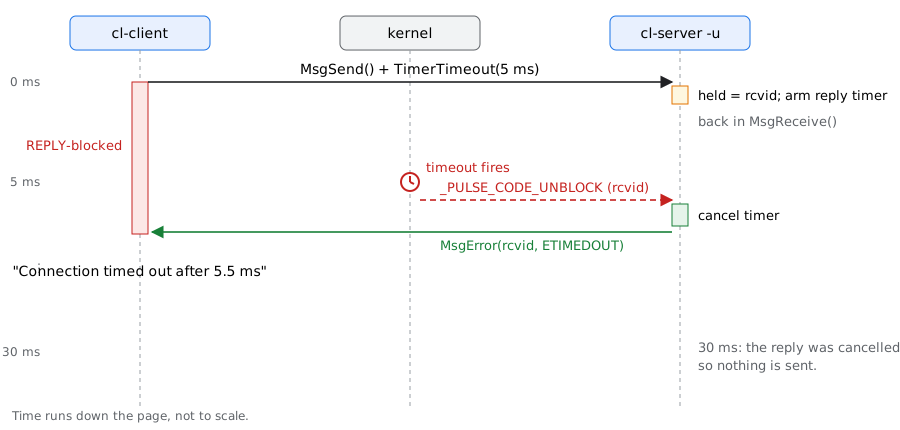
A server that can be slow must never sleep while it holds a request. Instead:
- Keep the request as a deferred reply. Save the
rcvidand go straight back toMsgReceive(). Nothing forces a server to reply before it receives the next message. - Reply later, from a timer. A one-shot timer sends the server a pulse when the answer is due.
- Answer the unblock pulse. If
_PULSE_CODE_UNBLOCKarrives for the heldrcvidfirst, cancel the timer and release the client withMsgError().
The exercise
Open server-todo.c on your host. It's the whole server, with two gaps marked TODO 1 and TODO 2. Everything else is in place: the timer reply_timer is created at startup with SIGEV_PULSE_INIT aimed at the server's own channel, so its PULSE_REPLY_DUE pulse arrives through the same MsgReceive() as everything else, and that case already sends the held reply.
- TODO 2, in the request path: stop sleeping. Keep the request so you can answer it later, and make
reply_timerfire once,delay_msfrom now. - TODO 1, in the
_PULSE_CODE_UNBLOCKcase: the client you're holding wants to leave. Release it with an error it will recognise as a timeout, and make sure your scheduled reply never goes out.
Do TODO 2 first. After each TODO, rebuild with make, copy cl-server-todo to the target, and run:
./cl-server-todo -d 30 -u & SP=$!; sleep 1
./cl-client -n 3
What you should see at each stage
Neither TODO done. Still the naive server:
ping 1: reply after 32.6 msOnly TODO 2 done. The server now holds the request and sees the unblock pulse for it (that printf is already in the TODO 1 branch), but nothing releases the client yet, so it still waits for the timer's reply:
server: client gave up waiting (TODO 1 decides what happens next)
ping  1: reply after 31.8 ms
Both done. The client's timeout works (the server's line is whatever you print in TODO 1):
ping  1: Connection timed out after 5.4 ms
ping  2: Connection timed out after 6.1 ms
It fires a little after 5 ms because timers expire on the system clock tick, 1 ms by default. Finally, check that a reply that is late but still inside the timeout is delivered normally:
./cl-server-todo -d 3 -u & SP=$!; sleep 1
./cl-client -n 3
ping 1: reply after 3.7 ms
ping 2: reply after 4.1 ms
ping 3: reply after 4.3 msHints
Try without them first. Each one gives away a little more.
- Hint 1 (TODO 2): the server already has two variables for this,
heldandheld_reply, and thePULSE_REPLY_DUEcase reads them. A one-shot timer is astruct itimerspecwith onlyit_valueset. - Hint 2 (TODO 1): which call lets a server answer a client with an error instead of data? And how do you disarm a timer you already armed?
- Hint 3, the code: TODO 2 is
held = rcvid; held_reply = r;, thenstruct itimerspec its = { 0 };withits.it_value.tv_sec = delay_ms / 1000;andits.it_value.tv_nsec = (delay_ms % 1000) * 1000000L;, thentimer_settime(reply_timer, 0, &its, NULL);. TODO 1 istimer_settime(reply_timer, 0, &off, NULL); MsgError(held, ETIMEDOUT); held = 0;. - Solution: the finished server is
server.c. It'scl-server -u.
The fixed server only helps while it can run. Freeze it and the client is stuck exactly as in step 5: nobody is left to answer the unblock pulse.
So a client with a deadline shouldn't call MsgSend() from its time-critical thread, at least not to a server it can't trust to answer. In cl-client -w, a 100 Hz loop at SCHED_FIFO priority 20 hands each request to a worker thread at priority 15 and never waits for it. It uses whatever answers have arrived, and keeps time either way:
clock_nanosleep(CLOCK_MONOTONIC, TIMER_ABSTIME, &next, NULL);
/* ... measure how late this tick is ... */
int idle = 0;                                        /* never wait for the server here */
if (atomic_compare_exchange_strong(&busy, &idle, 1)) sem_post(&go);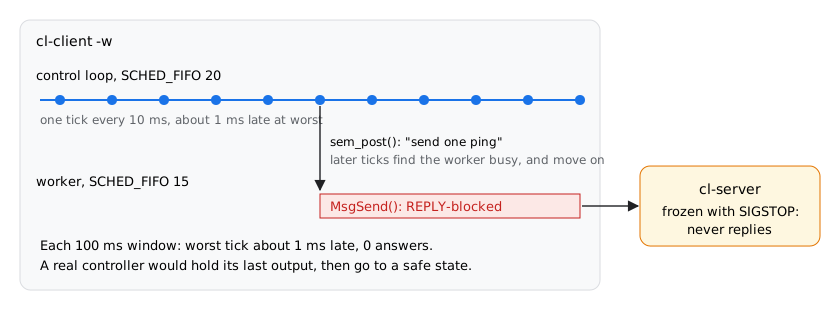
First, with a healthy server:
./cl-server > /dev/null & SP=$!; sleep 1
./cl-client -w -n 3
loop: 100 ms window 1, worst tick 1.03 ms late, 9 answers
loop: 100 ms window 2, worst tick 0.94 ms late, 10 answers
loop: 100 ms window 3, worst tick 0.93 ms late, 10 answersAbout 1 ms of lateness is the clock tick again: an absolute sleep wakes on the next tick.
./cl-server > /dev/null & SP=$!; sleep 1
./cl-client -w -n 5 & CP=$!
sleep 0.15; kill -STOP $SP
loop: 100 ms window 1, worst tick 1.13 ms late, 9 answers
loop: 100 ms window 2, worst tick 0.98 ms late, 6 answers
loop: 100 ms window 3, worst tick 1.01 ms late, 0 answers
loop: 100 ms window 4, worst tick 1.05 ms late, 0 answers
loop: 100 ms window 5, worst tick 1.10 ms late, 0 answersThe answers stop, but the loop stays on time. In a real controller, "0 answers" is what your fault handling reacts to: hold the last value, then go to a safe state.
The client still can't exit
When the loop finishes, look at the client again:
pidin -p cl-client -F "%a %b %N %p %J %B" pid tid name prio STATE Blocked
12304414 2 cl-client 15f REPLY 12292125Look at the server too, with pidin -p cl-server -F "%a %b %N %p %J %B":
     pid tid name               prio STATE          Blocked
17481757   1 cl-server           15r STOPPED
It started at the default priority 10, but it shows 15: when its thread received the worker's message, QNX gave it the sender's priority. That's priority inheritance through message passing, and here the server is stuck at the borrowed priority.
The worker thread (tid 2, priority 15 FIFO) is still REPLY-blocked on the frozen server, and as in step 5, even SIGKILL doesn't free it. What does free it is dealing with the server: resume it, or kill it. That's the job of a supervisor that watches heartbeats and kills a server that stops sending them. Faultline does exactly that with its fl-supervisor.
- Sleeping, or blocking on anything slow, while holding a request. The unblock pulse then waits behind your work, as in step 4. Defer the reply instead.
- **Reading the rcvid from
sival_int.**rcvid_tis 64-bit on QNX 8.0, so compare with(rcvid_t)msg.pulse.value.sival_long. - **Initialising
struct itimerspecby position.** POSIX doesn't fix the order of its members. The first version of this codelab's server wrote{ { 0, 0 }, { sec, nsec } }, meaning interval then value; on QNX 8.0 that leftit_valueat zero, which disarms the timer, so no held reply was ever sent. Setits.it_value.tv_secand.tv_nsecby name. - Trusting a timeout in a control loop. It only works if the server answers the unblock pulse. Keep
MsgSend()out of the time-critical thread. - Trying to unstick a client by killing it. A client REPLY-blocked on a frozen
_NTO_CHF_UNBLOCKserver survivedSIGKILLin our runs. Deal with the server.
Answer these without scrolling back. The answers are below.
- A client's
MsgSend()has a 5 msTimerTimeout()for SEND and REPLY. The single-threadedname_attach()server receives the message at once, then sleeps 20 ms before replying. How long does the client wait? - Same server, but it uses deferred replies and answers
_PULSE_CODE_UNBLOCKwithMsgError(rcvid, ETIMEDOUT). How long now, and what doesMsgSend()return? - Why doesn't the kernel just release the client when the timeout fires?
- A worker thread is REPLY-blocked on a frozen server. Name two things that release it, and one that doesn't.
- Your 100 Hz loop must never be more than 2 ms late, and it needs readings from a server that might freeze. Where should the
MsgSend()happen?
Answers
- About 20 ms. The client is REPLY-blocked, so the kernel only notifies the server with
_PULSE_CODE_UNBLOCK, and this server's only thread is asleep until it has replied. - About 5 ms (a little more, on the clock tick).
MsgSend()returns -1 witherrnoset toETIMEDOUT. - Because the channel has
_NTO_CHF_UNBLOCK, which everyname_attach()channel gets. That flag tells the kernel to hand the decision to the server, which may need to clean up work in flight for that client first. - Killing the server releases it at once (with
ESRCH). Resuming the server releases it as soon as the server replies or answers the unblock pulse. Killing the client, even withSIGKILL, didn't in our runs. - In a lower-priority worker thread. The loop only kicks the worker and uses whatever fresh data has arrived, so a frozen server costs it data, not deadlines.
What you learned
- Every
name_attach()channel has_NTO_CHF_UNBLOCK. Once the server has your message, **yourTimerTimeout()only works if the server answers the unblock pulse.** - In servers: never sleep or block while holding a request. Use deferred replies, and answer
_PULSE_CODE_UNBLOCKwithMsgError(). - In clients with deadlines: do the
MsgSend()from a lower-priority worker thread, and decide from fresh data, not from whether the call returned. - In the system: a frozen server can't release anyone, not even a client being killed. Detect it with heartbeats and kill it. That fails the request in flight with
ESRCH, and the client can reconnect to a restarted server.
Clean up
slay -s SIGCONT cl-server cl-server-todo 2>/dev/null; slay -s SIGKILL cl-server cl-server-todo cl-client 2>/dev/null
rm -rf /data/cl
Learn more
ChannelCreate(): the channel flags, including_NTO_CHF_UNBLOCK.TimerTimeout(): kernel timeouts for blocking states.MsgError(): releasing a client with an error.- Faultline: the fault-injection lab where this behaviour was found.